
The interbank rate and the open-market rate, side by side
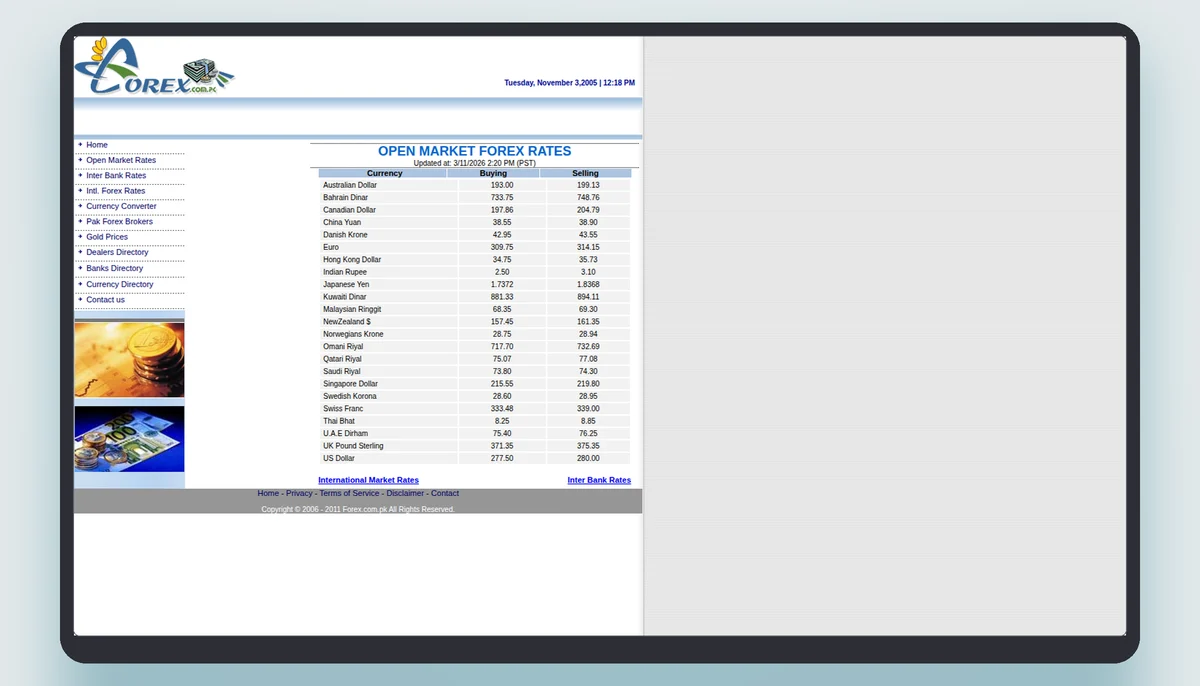
There are two dollar rates in Pakistan. The interbank rate is the rate banks use between themselves, published by the State Bank. The open-market rate is the counter quote from money changers. This page shows both with the date each belongs to, and the rupee gap between them.
The same dollar, two prices
The interbank rate against the open-market buying and selling price for one dollar.
| Rate | Rupees per dollar | Against interbank |
|---|---|---|
| Interbank (State Bank of Pakistan) | Rs 276.72 | +0.00% |
| Open market, buying | Rs 277.55 | +0.30% |
| Open market, selling | Rs 280.05 | +1.20% |
| Bank counter, telegraphic transfer | Rs 276.65 | — |
Interbank rate of: 02.11.2026
The interbank rate
The interbank rate is the rate banks use between themselves. It is published by the State Bank of Pakistan as the M2M revaluation rate, with a weighted-average interbank bid and offer. It is the rate a bank dealing room uses, not the rate a customer gets at a branch counter.
The State Bank publishes this rate each day that banks are open. It is the reference rate for large transactions between banks, and it is the rate that the open-market rate is compared against.
The open-market rate
The open-market rate is the dollar buying and selling price quoted by money changers and exchange companies. It is a counter quote, typed by hand, and varies by dealer. The buying price is the rate at which the money changer will buy dollars from you. The selling price is the rate at which the money changer will sell dollars to you.
The open-market rate is not published by the State Bank. It is the rate you will see on a board outside a money changer's shop, and it is the rate that matters if you are buying or selling cash dollars.
Why the buying price is below the selling price
The open market quotes a buying price below its selling price because the money changer must make a margin. The difference between the two prices is the money changer's profit on the transaction. It also covers the cost of holding cash dollars, the risk of the exchange rate moving, and the cost of running the shop.
The buying price is lower than the selling price by a few rupees on a dollar. That difference is the counter spread. It is the price you pay for the convenience of buying or selling dollars over a counter, in cash, without a bank account.
What the table shows
The table above shows the interbank rate and the open-market buying and selling price, each with the date it belongs to. The interbank figure is published by the State Bank. The open-market figure is a counter quote from forex.com.pk.
The table also shows the gap between the open-market selling price and the interbank rate, in rupees and as a per cent. The gap is the premium you pay to buy dollars over a counter rather than at the interbank rate.
How the two rates move
The interbank rate moves when the State Bank changes its reference rate, or when the weighted-average bid and offer move. The open-market rate moves when money changers change their board rates, which they do in response to demand and supply of cash dollars.
The two rates do not move in lockstep. The open-market rate can sit unchanged for a day while the interbank rate moves, or the open-market rate can move while the interbank rate stays put. The gap between them widens and narrows.
Why both rates matter
If you are a business importing or exporting, the interbank rate is the rate your bank will use for a large transaction. If you are a traveller buying dollars for a trip, or a family receiving money from abroad, the open-market rate is the rate you will get.
The two rates exist because the interbank market and the open market serve different customers with different costs. Knowing both rates, and the gap between them, is the first step to not paying more than you need to.
Key facts
Read next
Questions about today's dollar rate
Which rate should I watch if I am buying dollars?
If you are buying dollars over a counter, watch the open-market selling price. That is the rate the money changer will sell to you. The interbank rate is not available to you as a retail customer.
Which rate should I watch if I am receiving money from abroad?
If you are receiving money from abroad, the rate you get depends on how the money is sent. If it is sent through a bank, the bank will use a rate close to the interbank rate. If it is sent through a money transfer operator, the rate will be closer to the open-market rate.
Why is the open-market rate different from the interbank rate?
The open-market rate includes a margin for the money changer, the cost of holding cash dollars, and the risk of the exchange rate moving. The interbank rate is the rate banks use between themselves, with no cash handling and no retail margin.
Is the open-market rate the same everywhere in Pakistan?
No. The open-market rate varies by city and dealer. A money changer in Karachi may quote a different rate from one in Lahore. The figure on this site is a counter quote from forex.com.pk, which is a widely followed benchmark.
What is the M2M revaluation rate?
The M2M revaluation rate is a rate published by the State Bank of Pakistan for mark-to-market revaluation of foreign currency positions. It is used by banks to value their foreign currency assets and liabilities. On this site, it is the interbank rate shown.
Open a trading account with FxPro
This site is not the broker and takes no money from you. FxPro is an international broker that quotes currency pairs, including the dollar against other currencies, as contracts for difference. No cash dollars are bought, delivered or counted out. Opening an account requires identification and takes a day or two. A practice account exists and costs nothing.